


Most soap causes dry skin because it’s alkaline, and that alkalinity strips the lipids your skin needs to hold water. The fix is straightforward: switch to a low-pH or superfatted cleanser and moisturize while your skin is still damp. Harvard Health backs this exact approach, and it’s the same logic Ironwoodgrooming builds into every bar it makes.
TL;DR:
- Using low-pH or superfatted cleansers and moisturizing immediately after washing can significantly reduce soap-related skin dryness.
- Most traditional soaps have an alkaline pH that disrupts the skin’s acid mantle and strips vital lipids, increasing water loss within hours.
- Syndet bars and well-formulated moisturizing soaps are generally gentler, especially when they contain glycerin, ceramides, or superfatting oils, and have a pH near 5.5.
- Frequent handwashing, especially with harsh soaps, exacerbates skin barrier damage, so using humectant-based formulations and applying moisturizer during damp skin is recommended.
- Proper formulation, including residual fats and humectants, outweighs category labels like “soap” or “syndet” in determining how gently a cleanser treats sensitive or dry skin.
Table of Contents
- How Does Soap Cause Dry Skin?
- Bar Soap, Syndet, Or Body Wash: Which One Is Gentlest?
- A Simple Routine To Cleanse Without Wrecking Your Skin
- What Ingredients Actually Help (And Which Ones Make Things Worse)
- When Dry Skin Signals Something More Serious
- What A Beard-Focused Formulator Gets Right About This
- Surfactants Vs. True Soap: Why The Distinction Matters
- The Real Problem Isn’t Soap, It’s Sloppy Formulation
- Ironwood’s Approach To Dry, Sensitive Skin
- Sources
How Does Soap Cause Dry Skin?
Your skin’s outer layer runs slightly acidic, sitting around pH 4.7 to 5.5. Dermatologists call this the acid mantle, and it’s your first line of defense against bacteria, irritants, and water loss. Most true soap runs alkaline, closer to pH 9 or 10, and washing with it can shift your skin’s pH out of that healthy range for up to 90 minutes at a stretch.
That shift does more than feel dry. It disrupts the lipid layer, the mix of natural oils and ceramides that keeps water locked in. Once that layer thins out, dermatologists quoted in Time note that soap is often “too effective,” stripping away the same oils it’s designed to remove along with dirt. That’s when transepidermal water loss climbs, and skin starts feeling tight, flaky, or raw within hours of a shower.
Frequency compounds the problem. Wash twice a day with the wrong bar and you’re not giving your skin time to rebuild what it lost.
A few mechanisms drive most of the damage:
- Alkaline pH temporarily disables enzymes your skin needs for barrier repair.
- Detergent action removes sebum along with grime, leaving nothing to slow water loss.
- Bar residue and rinse-off speed both affect how long the disruption lingers on your skin.
Statistic to know: Healthy skin needs roughly 10% water content in its outer layer just to look and feel normal, according to Harvard Health. Strip enough lipid barrier and you drop below that threshold fast.
Bar Soap, Syndet, Or Body Wash: Which One Is Gentlest?
Not all cleansers work the same way, and the label rarely tells you the whole story. True soap is made by saponifying fats or oils with lye, which is exactly what gives it that alkaline pH. Syndet bars (“synthetic detergent”) use milder surfactants engineered to clean closer to skin’s natural pH, and liquid body washes fall anywhere on that spectrum depending on formulation.
Superfatting changes the equation. When a soapmaker leaves extra unreacted oil in the bar, that fat sits on your skin after rinsing instead of washing away completely. Formulations with residual lipids or glycerin help skin recover faster than a stripped-down detergent bar, even though the soap itself is still alkaline.
What to look for on a label:
- pH claims near 5.5, or language like “pH balanced.”
- Glycerin, ceramides, or fatty acids listed near the top of the ingredients.
- No sulfates (SLS/SLES) or heavy fragrance loads up front.
- “Superfatted” or “moisturizing base” as a formulation note, not just a marketing tagline.
If you’re choosing between a stripped bar soap and a well-made syndet, the syndet usually wins for daily body use. For beards and facial skin specifically, a well-crafted natural men’s bar soap built around superfats splits the difference: real soap performance without the harsh strip.
A Simple Routine To Cleanse Without Wrecking Your Skin
You don’t need a ten-step regimen. You need five steps done consistently, and moisturizer applied at the right moment.
- Turn the water down. Hot water accelerates lipid loss. Lukewarm is enough to clean effectively.
- Cap your shower at five to ten minutes. Longer exposure means more barrier disruption, especially with soap in contact the whole time.
- Soap only where you need it. Underarms, groin, feet. Skip lathering your entire torso and limbs daily.
- Pat dry, don’t rub. A towel dragged across dry skin adds mechanical irritation on top of chemical stripping.
- Moisturize within a couple of minutes, while skin is still damp. This traps residual water in the skin instead of letting it evaporate.
Frequent handwashing at work complicates this. If your job means washing ten or more times a day, you’re getting repeated pH shifts with no recovery window in between. WHO guidance on hand hygiene recommends humectant-containing formulations over plain soap in exactly this scenario, and keeping a small tube of hand cream at your desk isn’t overkill. It’s damage control.
Pro Tip: Layer your moisturizer with the water still on your skin, not after you’re fully dry. Damp skin absorbs a lotion or balm faster and locks in more of the water you’d otherwise lose to evaporation.
For a beard-specific version of this routine, proper beard soap technique matters just as much as picking the right bar.

What Ingredients Actually Help (And Which Ones Make Things Worse)
Ingredient lists tell you more than any front-of-bottle claim. A handful of names show up again and again on the wrong side of the ledger.
Common irritants to watch for:
- SLS and SLES (sodium lauryl/laureth sulfate): strong foaming agents that strip lipids aggressively.
- Heavy synthetic fragrance: a frequent trigger for irritation on already-compromised skin.
- Triclosan and other antimicrobials: useful in some clinical settings, unnecessary and irritating for daily use if you’re sensitive.
- High-alkalinity soap with no superfat: the classic dry-skin culprit.
Ingredients that actually help:
- Glycerin: a humectant that pulls water into the skin’s surface.
- Ceramides: rebuild the lipid matrix that soap breaks down.
- Urea and lactic acid: gently support the skin’s own moisture retention at low concentrations.
- Fatty acids from superfatting oils: replace some of what a cleanser removes.
Here’s the part most shoppers miss: a bar labeled “moisturizing” doesn’t actually add moisture. Soap cleans by removing oil, so gentler soaps simply remove less oil, or leave humectants and superfats behind to compensate. Trust the ingredient list over the front label, every time. This is the same logic behind grooming products built around barrier-friendly ingredients rather than vague marketing claims.
When Dry Skin Signals Something More Serious
Ordinary soap dryness fades once you switch products and moisturize consistently. Some symptoms mean it’s time to see a clinician instead of waiting it out:
- Cracking or bleeding skin, especially on hands or knuckles.
- A rash that spreads beyond the area you washed.
- Itching severe enough to disrupt sleep.
- Any swelling, blistering, or systemic symptoms like fever.
Who’s at higher risk: healthcare workers, food service employees, and anyone else washing hands frequently, along with people who already have eczema or a compromised barrier. WHO’s guidance on hand hygiene identifies frequent soap and detergent exposure as a leading cause of irritant contact dermatitis in exactly these occupational groups, and repeated washing without recovery time makes the underlying disruption worse each time.
If a rash keeps recurring with a specific product, a patch test through a dermatologist can distinguish irritant dermatitis from a true allergic reaction, and that distinction changes what you should avoid going forward.
What A Beard-Focused Formulator Gets Right About This
Robert has spent years looking at why grooming products fail men with coarse beards and reactive skin, and one pattern keeps showing up: most drying isn’t caused by a single bad ingredient, it’s caused by stacking small mistakes. Hot water, over-scrubbing, a high-pH bar, and skipped moisturizer all compound on top of each other.
Superfatted, small-batch bars deposit residual lipids and glycerin on the skin after rinsing, which gives the barrier something to work with instead of nothing. That’s not a cure for existing dermatitis, and it won’t outrun a genuinely irritating fragrance load. But paired with the routine above, it removes several of the compounding factors at once. If beard itch is part of your dry-skin story, understanding what triggers it closes the gap between a decent bar and a routine that actually holds up daily.
Surfactants Vs. True Soap: Why The Distinction Matters
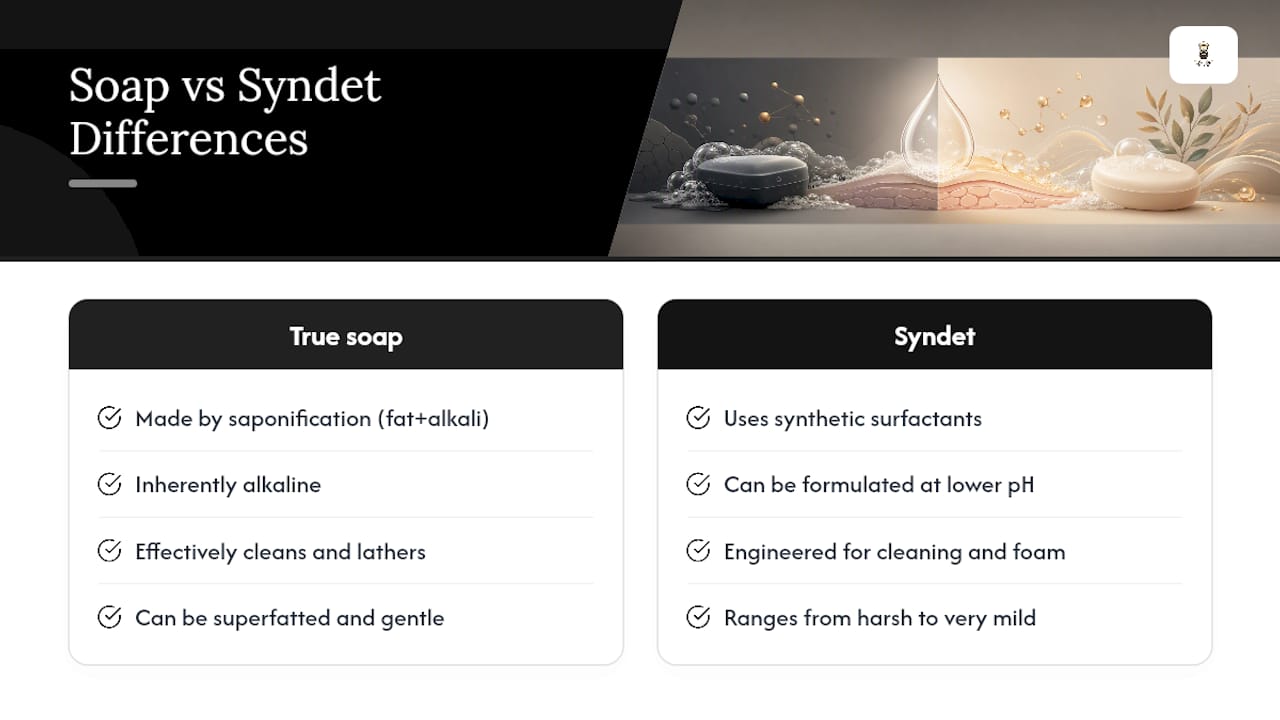
The word “soap” gets used loosely, and that’s part of why so many people stay confused about what’s drying out their skin. True soap comes from saponification: fat or oil reacting with an alkali to form a salt that lathers and lifts dirt. It’s effective, but its alkalinity is baked into the chemistry. You can’t make true soap that isn’t alkaline.
Syndet bars and most modern body washes work differently. They use synthetic surfactants, compounds engineered specifically for cleaning, that can be formulated at a lower, skin-friendlier pH. Some of these surfactants are just as aggressive as harsh soap, sometimes more so, if they’re chosen purely for foam and cost. Others are mild enough for daily facial use.
This is why “syndet” isn’t automatically synonymous with “gentle,” and “soap” isn’t automatically synonymous with “harsh.” The formulation details, which surfactant, how much fat is left unreacted, whether humectants are added back, decide the outcome far more than the category label does. Dermatologists interviewed by Time generally steer people toward syndets or well-formulated gentle cleansers for the body, reserving stronger soap mainly for situations that call for a tougher clean, like heavily soiled hands. A well-superfatted true soap can still outperform a poorly made syndet. Read the formulation, not the category.
The Real Problem Isn’t Soap, It’s Sloppy Formulation
Here’s where conventional advice oversimplifies things: “soap is bad, syndet is good” is a category-level shortcut that ignores formulation entirely. A cheap syndet loaded with sulfates can strip skin just as fast as a harsh bar soap, and a well-superfatted true soap can outperform both. The pH chemistry matters, but it’s not the whole story.
What actually predicts how your skin will feel after washing is the fat content left in the bar, the humectants added back, and how long the product sits on skin before rinsing. Most people chase ingredient lists looking for a single villain. That’s backward. Look instead at what’s left behind on your skin after rinsing, not just what’s stripped away.
If you take one thing from this: prioritize superfatting and humectant content over category labels, then layer good technique (lukewarm water, short exposure, immediate moisturizer) on top. Skip either half and you’re still fighting an uphill battle.
— Robert
Ironwood’s Approach To Dry, Sensitive Skin
Ironwoodgrooming builds every soap around the same principle covered above: leave enough fat and glycerin behind that your skin has something to work with, not just a stripped surface. The Reign Face & Beard Soap is formulated for daily use on sensitive skin without the harsh strip you’d get from a mass-market bar. If you’re dealing with a coarse beard on top of dry skin, the Lucky Beard Soap & Conditioner combines cleansing with conditioning in one step, so you’re not layering a drying cleanser under a separate rinse. For an added mineral-rich option that still leans gentle, the Black Salt Beard Soap & Conditioner works well for skin that reacts to fragrance-heavy products. Pick a fragrance-free option if you’re already reactive, follow the lukewarm-water-and-damp-moisturizer routine above, and give your skin a few washes to show the difference. Browse the full lineup and build your own sensitive-skin routine today.
This article is general information, not a substitute for advice from a qualified doctor. Consult a qualified healthcare professional about your own circumstances before acting on anything here.
Sources
- Dry skin - Harvard Health
- Dermatologists have a dirty little secret — Time
- Skin reactions related to hand hygiene - WHO Guidelines on Hand Hygiene in Health Care
- Does soap dry out your skin? The real reason (And what to use instead) - MarvelouSkin

