


For plant-based beard and skin care, the top vegan carrier oils are jojoba, argan, sweet almond, grapeseed, fractionated coconut (MCT), castor, rosehip, apricot kernel, and squalane. According to Healthline’s overview of carrier oils, these plant-derived fatty oils moisturize the skin beneath your beard, reduce itch, and soften coarse hair follicles — doing the real work that keeps your face feeling strong and conditioned. If you want a vetted, ready-made option instead of blending from scratch, Ironwoodgrooming’s vegan beard oils and butter deliver these exact ingredients in small-batch, transparent formulas built for men with coarse beards and sensitive skin.
Here’s the quick-reference list of the top vegan carrier oils for grooming:
- Jojoba — sebum-like, balanced, non-comedogenic, suits all skin types
- Argan — rich in vitamin E, softens coarse beard hair, gives a smooth finish
- Sweet almond — gentle, emollient, great for dry skin (check for nut allergies)
- Grapeseed — ultra-light, fast-absorbing, ideal for oily or acne-prone skin
- Fractionated coconut (MCT) — non-greasy, shelf-stable, lightweight daily base
- Castor — adds body and gloss; use sparingly or it turns sticky
- Rosehip — high in linoleic acid, supports skin repair and post-shave recovery
- Apricot kernel — silky slip, close to almond in feel but slightly lighter
- Squalane — derived from olives or sugarcane, featherweight hydration with no greasy residue
Pro Tip: Start with a two-oil base (jojoba + argan or jojoba + grapeseed) before adding specialty oils. Two well-chosen carriers cover slip, finish, and stability better than five mediocre ones.
Table of Contents
- What do the top vegan carrier oils actually do for your beard and skin?
- How do you choose the right carrier oil for your skin and beard?
- How to blend and use carrier oils safely for beard and facial grooming
- How do you buy quality carrier oils in the U.S. and store them properly?
- What are the allergy risks and common mistakes when using carrier oils?
- Why Ironwoodgrooming recommends these vegan carrier-blend approaches
- Key Takeaways
- The case for treating your grooming routine as a daily ritual
- Ironwoodgrooming’s vegan beard oils and butter: the ready-made path
- Useful sources for deeper research
What do the top vegan carrier oils actually do for your beard and skin?
The role of carrier oils in grooming goes well beyond simple moisture. Each oil has a distinct fatty-acid profile that determines how it absorbs, how it feels on your skin, and how it performs in a formula. The Tisserand Institute notes that carrier oils can constitute up to 99% of a beard oil formula, which means your carrier choice matters far more than the essential oil blend on top of it.
| Oil | Best for | Absorption / finish | Comedogenic rating | Typical grooming use |
|---|---|---|---|---|
| Jojoba | All skin types, daily use | Medium / dry-to-matte | Low | Beard oil base, daily moisturizer |
| Argan | Coarse or dry beards | Medium / smooth, slight sheen | Low–medium | Beard oil, post-shave conditioner |
| Sweet almond | Dry, sensitive skin | Medium / silky | Low–medium | Beard oil, pre-shave softener |
| Grapeseed | Oily or acne-prone skin | Fast / dry | Low | Lightweight beard oil, aftershave |
| Fractionated coconut (MCT) | All types, esp. fine beards | Fast / dry | Low | Daily base, lightweight blend |
| Castor | Thick, coarse beards needing gloss | Slow / heavy | Low–medium | Beard butter, conditioning blend |
| Rosehip | Sensitive or irritated skin | Medium / dry | Low–medium | Post-shave, skin-repair blend |
| Apricot kernel | Normal to dry skin | Medium / silky | Low–medium | Beard oil, aftershave |
| Squalane | All types, esp. sensitive | Fast / weightless | Low | Daily serum, lightweight beard oil |
| Meadowfoam | Long beards, dry ends | Slow / rich | Low | Conditioning treatment, beard butter |
Jojoba
Technically a liquid wax rather than an oil, jojoba mimics your skin’s natural sebum more closely than any other plant-derived carrier. That structural similarity means it absorbs without clogging pores and leaves a balanced, non-greasy finish. For men with combination skin or beards that tend to feel either too dry or too oily depending on the season, jojoba is the most reliable starting point. Learn more about jojoba in beard care and why it earns its place in nearly every serious formula.
Argan
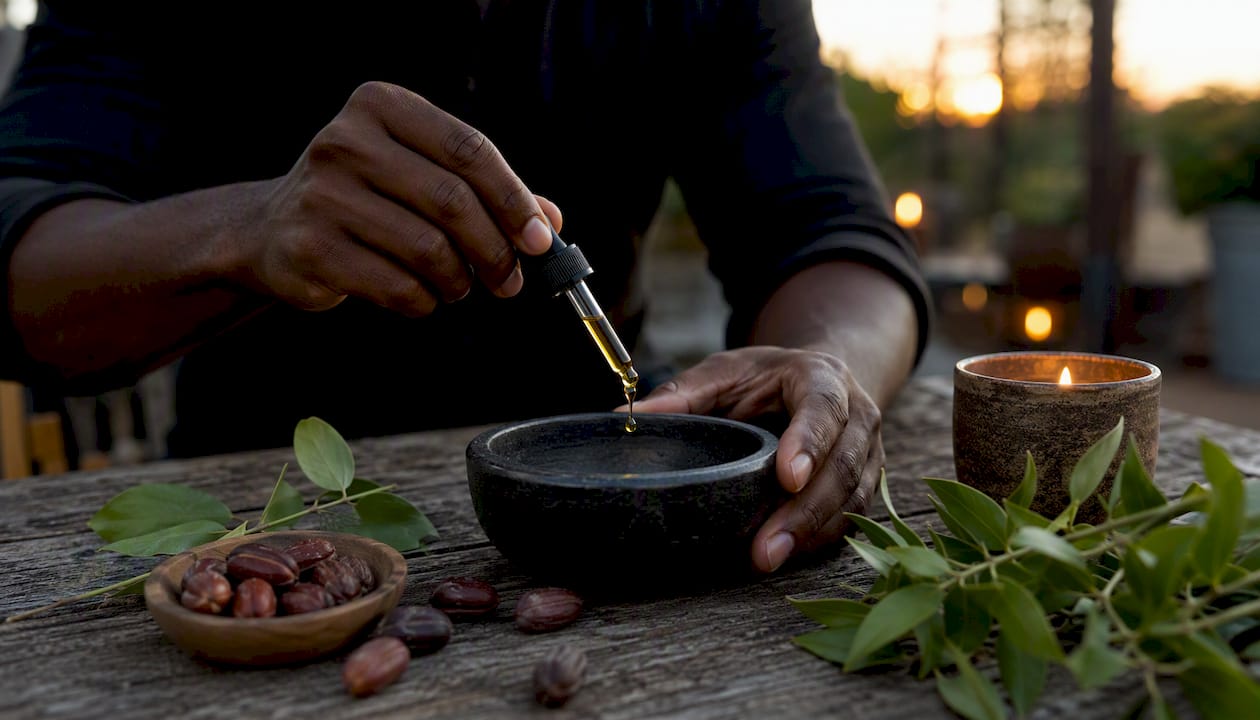
Pressed from the kernels of the Moroccan argan tree, this oil is dense with vitamin E and oleic acid. It gives coarse beard hair a noticeably softer, smoother feel after just a few applications. According to Balm Bench’s carrier oil breakdown, argan delivers a slightly glossier finish than jojoba, which makes it the better pick when you want a polished look without feeling greasy. The real role of argan oil in beard care goes deeper on this if you want the full picture.
Grapeseed
Cold-pressed from grape seeds, this oil is one of the lightest carriers available. It absorbs almost instantly, leaves no residue, and has a low comedogenic rating — making it the go-to for men with oily skin or anyone prone to breakouts along the jaw and neck. The tradeoff: it offers less conditioning than argan or sweet almond, so it works best as part of a blend rather than a solo carrier.

Fractionated coconut (MCT)
Unlike virgin coconut oil, the fractionated version has its long-chain fatty acids removed, leaving a clear, odorless liquid that stays liquid at room temperature and resists rancidity. Specialist vendors commonly market it as a non-greasy, shelf-stable base for lighter-feeling grooming oils — and that reputation holds up. It’s an excellent choice when you want a clean, neutral carrier that lets your essential oils shine without adding heaviness.
Castor
Castor oil’s high ricinoleic acid content gives it a thick, viscous texture that adds body and gloss to beard formulas. Used at 5–10% of a blend, it thickens the formula and adds a conditioning weight that lighter oils can’t match. Go above that range and the formula turns sticky fast. Think of it as a volume knob: a small turn adds presence; too much and you’ve overloaded the mix.
Pro Tip: When adding castor to a blend, start at 5% and test the feel on your wrist before committing to a full batch. Sticky residue on the beard is almost always a castor-ratio problem.
How do you choose the right carrier oil for your skin and beard?
The right oil depends on two things working together: your skin type and your beard’s texture and length. Get that match right and the oil disappears into your skin and hair, doing its job quietly. Get it wrong and you’re left with a greasy face or a beard that feels coated.
| Skin type | Beard / hair goal | Recommended carriers |
|---|---|---|
| Oily / acne-prone | Lightweight hydration, no breakouts | Grapeseed, jojoba, fractionated coconut |
| Dry / sensitive | Deep moisture, itch relief | Sweet almond, argan, apricot kernel |
| Combination | Balanced daily conditioning | Jojoba (solo or as base), squalane |
| Normal | Softness and shine | Argan, jojoba, sweet almond |
| Post-shave / irritated | Skin repair, redness reduction | Rosehip, squalane, apricot kernel |
| Coarse / thick beard | Body, gloss, conditioning weight | Argan + castor (5–10%), meadowfoam |
| Short beard / stubble | Fast absorption, no residue | Grapeseed, fractionated coconut, jojoba |
| Long beard (3+ inches) | Deep conditioning, frizz control | Argan, castor blend, meadowfoam |
A few decision rules worth keeping in mind:
- Oily or acne-prone skin: Reach for non-comedogenic, fast-absorbing oils. Grapeseed and jojoba both score low on the comedogenic scale and won’t compound existing congestion.
- Dry or coarse beards: Richer oils like argan, sweet almond, and a touch of castor deliver the fatty-acid density your hair follicles need. Don’t be afraid of a slightly heavier finish here.
- Short beards and stubble: The oil sits closer to skin than hair, so absorption speed matters most. Lighter carriers like fractionated coconut or grapeseed prevent that greasy-face feeling.
- Skin repair or sensitivity: Rosehip’s linoleic acid content supports the skin barrier, and squalane’s featherweight texture makes it tolerable even for reactive skin. Both work well in post-shave blends.
For a side-by-side look at jojoba vs. argan for beards, Ironwoodgrooming’s comparison guide breaks down the practical differences in feel, finish, and best-use scenarios.
How to blend and use carrier oils safely for beard and facial grooming
Building your own beard oil is straightforward when you follow a clear process. The Tisserand Institute’s formulation guidance recommends keeping essential oils at approximately 1% concentration for facial application. That’s a firm ceiling for facial use, not a target to push against.
Key dilution rule: Essential oils at 1% for facial application means 6–7 drops per 1-oz bottle. Carrier oils fill the remaining 99% of the formula and do the real conditioning work.
Three starter recipes for a 1-oz bottle
Daily beard oil (balanced, all skin types)
- 50% jojoba + 40% argan + 10% fractionated coconut
- Add 6 drops of your chosen essential oil (cedarwood, sandalwood, or frankincense work well)
Heavy conditioning oil (coarse or long beards)
- 50% argan + 40% sweet almond + 10% castor
- Add 6 drops essential oil; the castor adds body without overwhelming the blend
Post-shave soothing oil (sensitive or irritated skin)
- 50% sweet almond + 30% rosehip + 20% squalane
- Add 5 drops lavender or chamomile essential oil for additional calming effect
Application steps
- Patch test first (see the safety section below) before applying any new blend to your face.
- Apply after a warm shower when your pores are open and your beard hair is slightly damp. Absorption is noticeably better at this point.
- Use 3–4 drops for short beards and stubble; 5–8 drops for medium beards; 8–12 drops for longer beards.
- Warm the oil between your palms, then work it into the skin beneath the beard first. The skin is the priority. Then distribute through the beard hair with your fingers.
- Finish with a beard comb or brush to distribute evenly and train the hair.
After mixing a new blend, let it sit for at least 24 hours before using it. The Tisserand Institute notes that this melding period allows the scent profile to stabilize and the oils to integrate fully, which affects both aroma balance and perceived finish.
A practical starting formula from formulation guides: equal parts jojoba and sweet almond as the base, with essential oils added at approximately 1%, stored in amber glass. Most carrier oils have a typical shelf life of several months., so keeping batches small extends freshness and reduces waste.
Pro Tip: Mix a 0.5-oz test batch before committing to a full ounce. Scent and feel can shift once the oils meld, and a small test batch saves you from wasting a full bottle of expensive argan.
How do you buy quality carrier oils in the U.S. and store them properly?
Quality signals matter because carrier oils vary enormously between suppliers. A cold-pressed argan oil and a solvent-extracted argan oil carry the same name on the label but deliver very different results on your skin.
Buying checklist
- Processing method: Look for “cold-pressed” or “expeller-pressed” on the label. These methods preserve the oil’s natural fatty acids and vitamins. “RBD” (refined, bleached, deodorized) oils are more shelf-stable but lose some beneficial compounds.
- Virgin vs. refined: “Virgin” or “extra virgin” labels indicate unrefined oils that retain their natural color, scent, and nutrient profile. Refined oils are more neutral and often better for sensitive skin or blends where you want a clean base.
- INCI list transparency: The ingredient list should use standardized INCI (International Nomenclature of Cosmetic Ingredients) names. If a supplier won’t publish a full INCI list, that’s a red flag.
- Certifications: USDA Organic certification and COSMOS certification are the two most credible markers for organic carrier oils in the U.S. market. Neither is mandatory, but their presence signals a supplier who has submitted to third-party verification.
- Batch numbers and lot codes: Small-batch suppliers who publish batch numbers give you traceability. If a product ever causes a reaction, you can identify exactly what you used. Ironwoodgrooming provides this kind of transparency as a standard part of its small-batch approach.
- Packaging: Amber or cobalt glass protects oils from UV degradation. Minimal headspace in the bottle slows oxidation. Tamper-evident seals confirm the product hasn’t been opened before you.
The ACHS carrier oils guide covers these quality signals in detail and is worth bookmarking if you plan to source individual oils for blending.
For confirming vegan claims and ingredient transparency before you buy, Ironwoodgrooming’s guide on identifying vegan beard products walks through exactly what to look for on labels.
Storage best practices
Most carrier oils stay fresh for 6–12 months when stored correctly. Refined and fractionated oils tend to last longer than virgin oils because the refining process removes the compounds most prone to oxidation.
- Store in a cool, dark place away from direct sunlight and heat sources.
- Keep lids tight after each use to minimize air exposure.
- Rancidity shows up as a sour, crayon-like, or paint-like smell. If your oil smells off, it’s off. Don’t use it on your face.
- Vitamin E (tocopherol) added at 0.5–1% of the formula acts as a natural antioxidant and extends shelf life modestly.
Pro Tip: Write the date you opened each oil on the bottle with a marker. Carrier oils don’t announce when they’ve turned — you have to track it yourself.
What are the allergy risks and common mistakes when using carrier oils?
“Natural” doesn’t mean risk-free. Some of the most popular carrier oils carry real allergy potential, and a few common formulation habits can cause more problems than they solve.
Allergenic oils and patch testing
Sweet almond oil is one of the most widely used carriers in grooming products, and it’s also a tree-nut oil. If you have a tree-nut allergy, treat it with the same caution you’d apply to eating almonds. Apricot kernel oil carries similar risk. Nikura’s product guidance on sweet almond oil explicitly flags this allergy risk and recommends patch testing before facial use.
How to patch test:
- Apply 2–3 drops of the oil (or blend) to the inside of your forearm or behind your ear.
- Leave it uncovered for 24 hours.
- If you see redness, swelling, or feel itching, wash the area and don’t use that oil on your face.
- No reaction after 24 hours means you’re clear to proceed with a small facial application.
If you have a known nut allergy, substitute grapeseed, jojoba, or fractionated coconut, all of which carry a much lower allergenic profile.
Oils and ingredients to avoid for facial use
- Undiluted essential oils: Never apply cinnamon, clove, oregano, or thyme essential oils directly to skin. Even diluted, these “hot” oils require extra caution on facial skin.
- High-comedogenic oils for acne-prone skin: Wheat germ oil and coconut oil (virgin, not fractionated) score high on the comedogenic scale and can trigger breakouts in pore-sensitive skin.
- Animal-derived ingredients: Lanolin, beeswax, and emu oil appear in many conventional grooming products. None are vegan. Check INCI lists carefully. Ironwoodgrooming’s guide on vegan alternatives to lanolin covers plant-based substitutes that perform just as well.
Common formulation mistakes
Too much castor oil, too many heavy carriers, or skipping the patch test are the three mistakes that send men back to synthetic products. Fix the ratio, simplify the blend, and test before you commit.
- Overloading castor: Above 10–15% in a blend, castor turns sticky and coats the beard rather than conditioning it. Keep it at 5–10% for body without the residue.
- Stacking heavy oils: Combining argan, castor, and meadowfoam in equal parts creates a formula too rich for daily use. Reserve heavy blends for weekly conditioning treatments.
- Ignoring comedogenic layering: If you’re already using a moisturizer with coconut oil, adding a beard oil with the same ingredient doubles the comedogenic load on your skin. Map what you’re already applying before you build a new blend.
- Skipping the dermatologist: Persistent redness, breakouts, or irritation that doesn’t resolve after switching oils warrants a visit to a dermatologist. Carrier oils are generally safe, but individual skin conditions can complicate the picture.
Why Ironwoodgrooming recommends these vegan carrier-blend approaches
Ironwoodgrooming’s approach to vegan grooming products is built on a straightforward principle: the carrier blend does the work, and every ingredient in the formula needs to earn its place. That philosophy shows up in the three products the brand recommends for different grooming needs.
| Product | Primary carriers | Best for | Finish |
|---|---|---|---|
| Authentic Essential Beard Oil | Jojoba-forward blend | Daily hydration, all beard lengths | Balanced, non-greasy |
| Eviden Essential Beard Oil | Argan-forward blend | Polish and performance, medium-to-long beards | Smooth, slight sheen |
| Authentic Vegan Beard Butter | Plant wax + conditioning carriers | Coarse beards, styling, weekly conditioning | Rich, light hold |
The Authentic Vegan Beard Butter uses plant-based waxes (candelilla is harder than beeswax and requires adjusted ratios in vegan balm formulations) rather than animal-derived beeswax, keeping the formula fully plant-based without sacrificing hold. That’s a formulation detail most brands gloss over; Ironwoodgrooming addresses it directly in its ingredient transparency.
Small-batch production means each batch carries a traceable lot number, which gives you the kind of sourcing confidence that large-scale manufacturing can’t offer. Every formula avoids fillers, synthetic fragrances, and animal-derived ingredients, with a full INCI list available so you know exactly what you’re putting on your face.
Pro Tip: If you’re new to plant-based grooming, start with the Authentic Essential Beard Oil as your daily driver. It’s formulated to work across skin types and beard textures, which makes it the lowest-risk entry point before you experiment with heavier conditioning products.
Ingredient transparency isn’t a marketing claim — it’s a baseline requirement. If a brand won’t publish its full INCI list, that’s the only signal you need to look elsewhere.
Key Takeaways
The most effective vegan grooming routine starts with the right carrier oil base: jojoba and argan cover the majority of skin types and beard textures, essential oils stay at 1% for facial safety, and small-batch sourcing with full INCI transparency separates quality products from filler-heavy alternatives.
| Point | Details |
|---|---|
| Start with two carriers | Jojoba and argan cover most skin types; add specialty oils only when you have a specific need. |
| Essential oil dilution | Keep essential oils at approximately 1% (6–7 drops per ounce) for safe facial application. |
| Storage and shelf life | Most carrier oils stay fresh for 6–12 months; store in amber glass in a cool, dark place. |
| Patch test every new blend | Apply to your forearm for 24 hours before using any new oil or formula on your face. |
| Ironwoodgrooming ready-made options | The Authentic Vegan Beard Butter and beard oils deliver vetted, transparent vegan formulas for coarse beards and sensitive skin. |
The case for treating your grooming routine as a daily ritual
There’s a tendency among men to treat beard care as a problem to solve once and then forget. Buy a product, use it occasionally, wonder why the beard still feels rough. The reality is that skin-first, plant-based grooming works through consistency, not intensity.
Three to six drops of a well-chosen carrier oil after your morning shower, worked into the skin beneath the beard before you distribute it through the hair, takes about 90 seconds. Done daily, that habit builds a moisture baseline your skin and beard maintain between applications. Done sporadically, you’re always playing catch-up.
The sensory side of this matters too. A blend that smells right to you is one you’ll actually use every day. That’s why aroma balance in your carrier and essential oil blend isn’t vanity. It’s the practical reason the routine sticks. Men with coarse beards or sensitive skin often find that the ritual itself, the warmth of the oil, the scent, the two minutes of deliberate care, becomes the reason they stay consistent. And consistency is what produces the results.
For men transitioning from synthetic products, the shift to natural grooming products can take two to four weeks as your skin recalibrates. Stick with it. The payoff is a beard and skin that respond to what you put on them rather than just tolerating it.
Ironwoodgrooming’s vegan beard oils and butter: the ready-made path
If blending your own formula sounds like more work than you want right now, Ironwoodgrooming has already done it for you, with full ingredient transparency and small-batch traceability built in.
The Authentic Essential Beard Oil is the daily workhorse: a jojoba-forward blend designed for all beard lengths and skin types, absorbs clean, and reduces itch without leaving a greasy residue. For a more polished finish on medium-to-long beards, the Eviden Essential Beard Oil delivers an argan-forward formula with a smooth, refined sheen. And for coarse beards that need real conditioning weight or light styling hold, the Authentic Vegan Beard Butter uses plant-based waxes and conditioning carriers to soften and shape without animal-derived ingredients.
Every product ships with a full INCI list, batch number, and the kind of American craftsmanship that shows up in the formula, not just the branding. Visit Ironwoodgrooming to pick the product that matches your beard length and skin type, and get your daily routine locked in.
Useful sources for deeper research
These are the primary references behind this guide. Each one is worth bookmarking if you want to go further into formulation, safety, or ingredient science.
- Healthline: Carrier oils overview — A solid starting point for understanding how plant-derived oils benefit skin and hair, with accessible explanations of fatty-acid profiles.
- Tisserand Institute: Formulation and safety guidance — The authoritative source for essential oil dilution ratios and blending safety, including the 1% facial dilution standard and the 24-hour melding recommendation.
- ACHS: Carrier oils guide — A practitioner-level breakdown of quality signals (cold-pressed, INCI lists, certifications) for sourcing carrier oils in the U.S.
- Balm Bench: Carrier oils for beard care, explained — Practical guidance on how different oils change the feel and finish of a beard oil formula, with useful comparisons between jojoba, argan, castor, and grapeseed.
- Ironwoodgrooming: Vegan beard oil ingredients guide — A brand-specific breakdown of ingredient choices and trade-offs for vegan beard oil formulas, grounded in the same plant-based principles covered here.

